

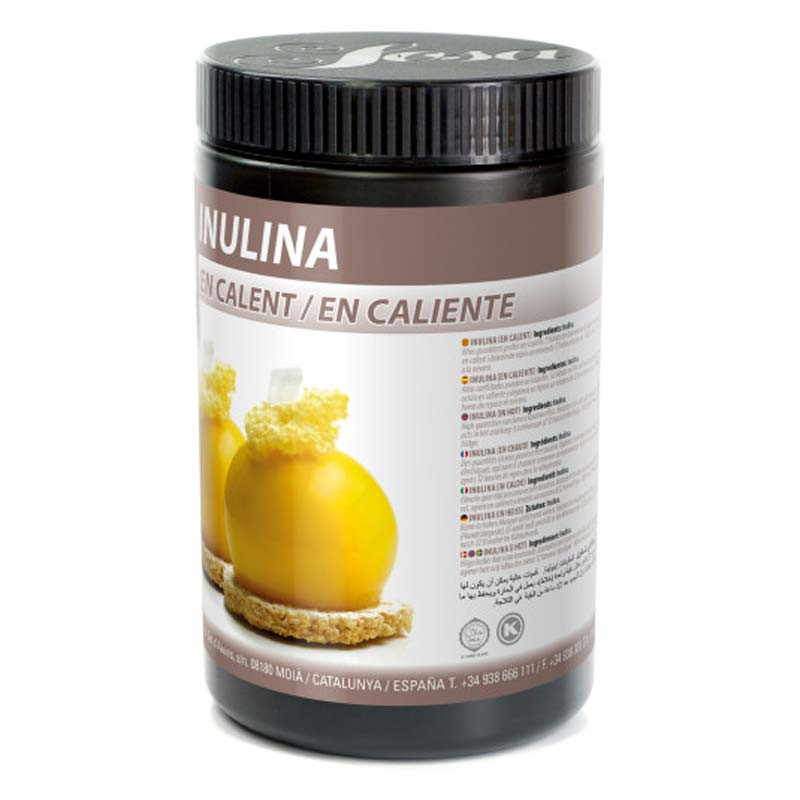
Sosa Inulin, 500 g

Description
Inulin Sosa is a fructan (a polymer of fructose molecules), which is usually found in the roots, tubers and rhizomes of certain plants, such as burdock, chicory and dandelion, as a storage substance. It is a type of dietary fibre. Its name derives from the first plant from which it was isolated in 1804, Helenium (Inula helenium).
Inulin is used in food processing due to its starch-like properties (note that, under European legislation, inulin is not a food additive).
Inulin can be used as a flour substitute, without imparting any flavour and with a texture very similar to that of fat. In addition to these properties, it is interesting to note that the metabolism of inulin yields 1.5 kcal.
Consequently, in many products, particularly dairy products and ice cream, inulin is used to replace fats.
It has the ability to form gels that retain a large amount of water.
Directions for use: Dissolve in liquid at 70 °C to ensure complete dissolution. Once incorporated into the liquid, the mixture must be left at 5 °C for 2 hours to set properly, after which it can be frozen. Thermoreversible between 35 and 40 °C.
Dosage: 50–200 g/kg of liquid
. Recommended use: replaces fats in mousses, ice cream and creams.
Quantity: 500 g.
Details
What customers are saying
Recommended Products
-

-
-
-
-
-
-
Pectin Pudra Pectin Yellow So Soda, 500 gr€24.72 / buc€20.43 / buc (VAT excluded)Available to order
-
-
-